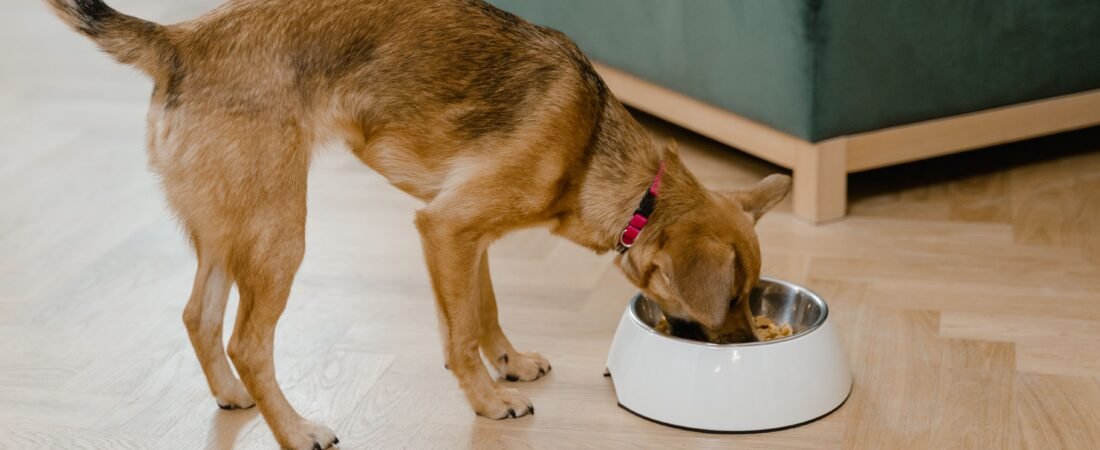
If you’re wondering where to put dog bowls in a small kitchen, start with the quiet edges of the room rather than the most obvious empty patch of floor. An unused corner, the end of a cabinet run, or the outer side of an island can give your dog a comfortable feeding spot without putting bowls in the path between the refrigerator, sink, and stove.
The best location isn’t simply somewhere two bowls fit. Your dog needs enough room to approach, eat or drink comfortably, and walk away, while you still need to open cabinets, appliances, and doors without moving the feeding station every time. Water spills and cleaning matter too, especially when space is tight.
Before making a location permanent, put the bowls there for a day or two and use the kitchen normally. Open the refrigerator and dishwasher, prepare a meal, walk through the room, and watch where your dog stands after drinking. A short trial usually exposes problems that aren’t obvious when the bowls are empty.
Quick Answer: Where Should Dog Bowls Go in a Small Kitchen?
In most small kitchens, dog bowls work best around the perimeter in a quiet, easy-to-clean spot outside the main traffic path. Look for space that isn’t needed for appliance doors, cabinet access, seating, or regular foot traffic.
Nine locations worth testing are:
- the outer end of a kitchen island
- an unused kitchen corner
- beside the refrigerator, where clearance allows
- the end of a cabinet run
- under an open shelf or narrow wall area
- a recessed nook or alcove
- an unused breakfast-bar overhang
- near a pantry or utility area
- just outside the kitchen
Which one works best depends on your kitchen layout and your dog’s drinking habits. A neat eater may need very little floor protection, while a large dog that splashes or pushes the bowl around needs more clearance.
Before Choosing a Spot, Check These 7 Things
A feeding spot can look perfect when the kitchen is quiet and become a nuisance as soon as someone starts cooking. Before buying a mat, feeding station, or storage unit, test the space against the way your household actually uses the room.
- Give your dog enough room. Your dog should be able to approach the bowls, stand naturally, eat or drink, turn, and leave without squeezing between furniture or people.
- Stay out of the main walkway. If everyone has to step around your dog at mealtimes, the location is too busy. This matters particularly in narrow galley kitchens.
- Open everything nearby. Test the refrigerator, dishwasher, oven, pantry door, drawers, and lower cabinets rather than assuming there is enough clearance.
- Plan for spilled water. Look at the flooring and nearby cabinets, then allow enough protected space for your dog’s normal splash zone.
- Make cleaning easy. Kibble, hair, and water eventually find their way beyond the bowls, so avoid spaces that are difficult to sweep, wipe, or dry.
- Keep the water easy to check. Hiding the bowl may make the kitchen look tidier, but you still need to notice when it needs cleaning or refilling.
- Watch your dog’s reaction. Some dogs will eat anywhere; others may hesitate in a cramped corner or a spot where people continually pass behind them.
If your dog pushes the bowls across smooth flooring, solve that before deciding a location doesn’t work. Our guide on how to stop dog bowls sliding around the floor covers simple ways to stabilize the feeding area.
These 9 space saving spots are suitable for your dog bowls
1. At the End of a Kitchen Island
The outer end of an island is often one of the most useful places for dog bowls because it turns otherwise empty floor space into a defined feeding area. The island also gives the station a natural boundary, so the bowls don’t feel as though they’ve been dropped randomly into the middle of the kitchen.
Choose the quiet end rather than the side used for cooking, drawers, stools, or frequent foot traffic. Stand where your dog will eat and look at what happens around that position. If someone carrying a hot pan has to step around the dog to reach the sink, it isn’t the right end of the island.
Allow enough room for a waterproof mat if the water bowl splashes. The mat should protect the actual wet area without extending so far into the walkway that it becomes another obstacle.
Best for: Kitchens with an island end outside the main working area.
Skip it if: The same space is regularly used for stools, chairs, or kitchen traffic.
2. In an Unused Kitchen Corner
An empty corner isn’t the most inventive solution, but in a small kitchen that’s often an advantage. It keeps the bowls around the edge of the room, gives your dog a predictable feeding spot, and doesn’t require custom cabinetry or another piece of furniture.
Don’t push the bowls tightly against both walls just to save a few inches. Leave enough space for your dog to stand naturally and move away without backing into a cabinet. If the corner is beside painted walls or cabinet panels, check where water lands after your dog drinks and wipe repeated splashes before they sit.
A simple corner setup may need nothing more than the bowls, a properly sized non-slip mat, and perhaps a nearby towel for a dog that walks away dripping. Keeping the station visually simple also prevents a small kitchen from feeling more crowded than it is.
Best for: Renters and kitchens with a genuinely unused corner.
3. Beside the Refrigerator
The narrow area beside a refrigerator can look like wasted space, and sometimes it makes an excellent feeding spot. The deciding factor is clearance. Open the refrigerator completely and pull out any internal drawers you use regularly. Make sure the bowls, mat, and dog won’t interfere with the door or with your ability to stand in front of the appliance.
Also consider how often your household uses the refrigerator. A technically empty gap isn’t useful if someone has to ask the dog to move every time they want milk. For a quiet side of the fridge with generous clearance, though, the location can keep bowls neatly against the perimeter.
Best for: Kitchens with real clearance beside the refrigerator.
Skip it if: The refrigerator door swings toward the bowls or the area forms part of a busy route through the kitchen.
4. At the End of a Cabinet Run
Look at the point where your lower cabinets finish. In an L-shaped or open-plan kitchen, there may be a short stretch between the last cabinet and a wall, doorway, or adjoining room that isn’t large enough for furniture but gives a dog enough room to eat comfortably.
This is particularly useful when the bowls can sit beside the cabinet rather than directly in front of it. Nothing needs to be opened above them, and the cabinet end helps visually define the feeding area.
If the water bowl sits close to a cabinet panel, check it for splashes rather than concentrating only on the floor. For a dog that creates a wider wet area, use enough floor protection to catch the normal mess without pushing the feeding station farther into the room.
Best for: L-shaped kitchens and open-plan layouts with unused space at the end of cabinetry.
5. Under an Open Shelf or Along a Narrow Wall
A short section of unused wall can become a compact feeding area without adding a bulky dog station. Keep the bowls at floor level and, if you genuinely need the storage, use the wall above for a shallow shelf holding a few feeding essentials.
This works best when you keep the vertical storage restrained. A small kitchen can quickly look cluttered if every dog accessory ends up hanging above the bowls. Store only things you regularly use there, such as a feeding scoop, clean dog towel, or a small container of treats, and keep heavier supplies elsewhere.
Make sure nothing stored above an open food or water bowl can easily fall into it. The floor underneath should also remain accessible enough to wipe without moving half the kitchen.
Best for: Kitchens with limited floor space but a quiet strip of unused wall.
6. Inside a Recessed Nook or Alcove
An awkward recess that isn’t useful for furniture can be almost ideal for dog bowls. It naturally keeps the feeding station out of the main walkway while giving your dog a clearly defined place to eat and drink.
The nook still needs to be large enough for the dog, not just the bowls. Before committing to it, check that your dog can enter and leave comfortably, you can remove the bowls without difficulty, the floor is easy to clean, and water won’t continually splash onto a surface that is hard to dry. If all of those conditions work, you’ve probably found one of the best kinds of small-space storage: an awkward piece of the room that finally has a useful job.
Best for: Kitchens with small alcoves, recessed walls, or unusual leftover spaces.
7. Under an Unused Breakfast-Bar Overhang
A breakfast-bar overhang can tuck much of the feeding station out of normal view, but only if that part of the bar isn’t used for seating. Bowls, stool legs, feet, and a dog’s head all competing for the same narrow space will make the kitchen feel smaller rather than larger.
Use an unused end of the overhang and test it with the nearby stools pulled out. Your dog should still be able to stand comfortably, and people should be able to walk past without stepping over the edge of the feeding mat.
Best for: Breakfast bars with an end section that isn’t used for seating.
8. Near a Pantry or Utility Area
A spot near a pantry, laundry, or utility area can work well because food storage and cleaning supplies may already be nearby. The important distinction is near the pantry rather than automatically hiding the bowls inside it. Your dog’s water should remain easy to reach, and you should be able to see when the bowl needs cleaning or refilling.
The edge of a pantry entrance can also move the feeding station away from the busiest food-preparation area without making your own routine inconvenient. If the adjoining utility space contains noisy appliances, test the location while they’re running. A space-saving spot isn’t useful if your dog is reluctant to use it.
Best for: Kitchens that open directly into a pantry, laundry, mudroom, or utility area.
9. Just Outside the Kitchen
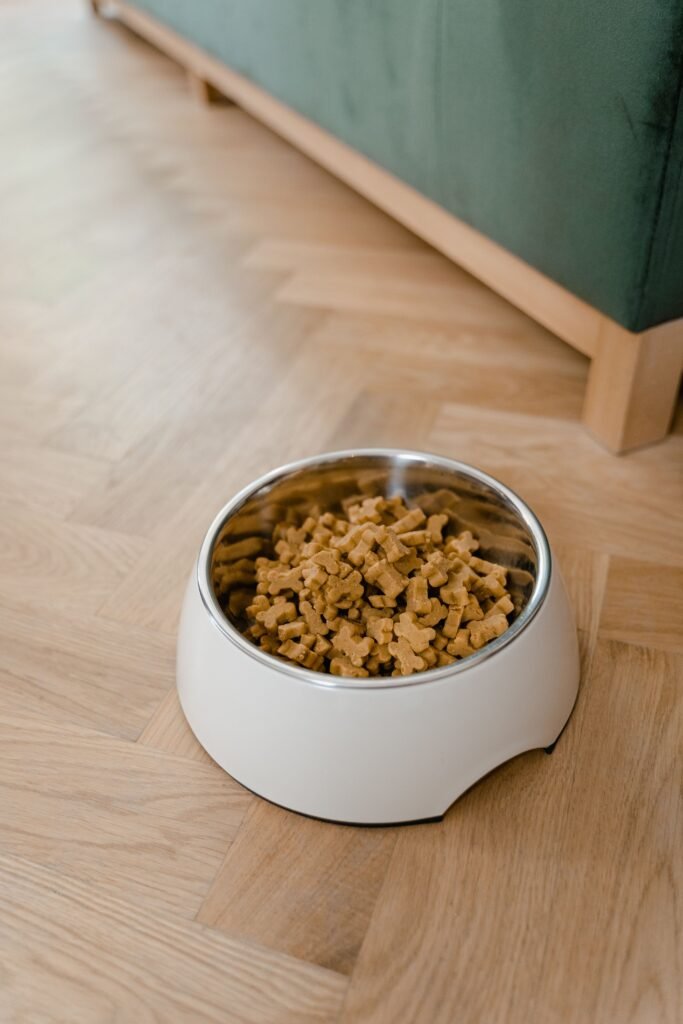
Sometimes the smartest answer to where to put dog bowls in a small kitchen is a few feet outside the kitchen. If every available position blocks a cabinet, appliance, doorway, or walking route, forcing the bowls into the room doesn’t make the space more efficient.
Look at the edge of the dining area, a nearby laundry entrance, mudroom, hallway recess, or the boundary between the kitchen and living space. In an open-plan home, moving the bowls just beyond the kitchen can give your dog considerably more room while keeping refilling and cleaning convenient.
The same dead-space principle works for other bulky dog essentials. Our guide on where to put a dog crate in a small house looks at ways to fit a crate into a smaller home without sacrificing the main living areas.
Best for: Tiny kitchens and narrow galley layouts where there simply isn’t a practical feeding position inside the room.
Best Dog Bowl Spots by Kitchen Layout
If several locations seem possible, your kitchen shape can narrow the choice quickly. Start with the area least likely to interfere with the room’s normal movement.
| Kitchen layout | Try first | Watch for |
|---|---|---|
| Galley kitchen | End of cabinet run or just outside the kitchen | Narrow central walkway |
| L-shaped kitchen | Unused corner or cabinet end | Appliance and cabinet doors |
| Kitchen with island | Quiet outer end of island | Cooking and seating sides |
| Open-plan kitchen | Cabinet end or dining-area transition | Through traffic |
| Breakfast bar | Unused end of overhang | Stools, feet, and chair movement |
| Very small kitchen | Immediately adjacent room | Forcing bowls into a walkway |
Galley kitchens usually benefit from keeping bowls at one end rather than in the narrow middle. L-shaped kitchens often have a usable corner or cabinet end, while islands create possibilities along the side facing away from food preparation. In an open-plan layout, don’t be constrained by the imaginary line where the kitchen finishes. The dining-area transition may be the most practical spot in the entire space.
Where Not to Put Dog Bowls in a Small Kitchen
Knowing where to put dog bowls in a small kitchen becomes much easier once you rule out spaces that create predictable problems. A location isn’t saving space if the bowls need to be moved several times a day.
- In the main cooking path: Avoid the route people repeatedly take between the refrigerator, sink, stove, and main work surface.
- Directly in front of cabinets or drawers: Moving the feeding station whenever you need a pan or cleaning product quickly becomes irritating.
- In front of the dishwasher or oven: Both require considerable clearance when their doors are open.
- Across a doorway: A doorway isn’t spare floor space if people need to walk through it.
- Somewhere difficult to clean: Water, kibble, and dog hair will eventually escape the feeding area, so you need to be able to reach the floor around it.
- Somewhere the water becomes inaccessible: Don’t hide the drinking bowl behind a closed door or in a space your dog can’t reliably reach.
Water accessibility matters more than making the kitchen look perfectly uncluttered. The American Kennel Club’s dog-bowl guidance emphasizes providing fresh drinking water and keeping water bowls clean, so choose a position that makes both easy to manage.
Should Food and Water Bowls Stay Together?
They can, but a small kitchen doesn’t require them to occupy exactly the same footprint. Treating the bowls separately can sometimes make the layout work better.
A dog that splashes heavily may need more protected space around the water bowl than around the food bowl. Separating them slightly can also prevent water from repeatedly landing in dry food. On the other hand, if your dog eats and drinks neatly and both bowls fit comfortably in one low-traffic spot, keeping them together is simple and convenient.
Don’t separate them simply because it looks more organized in a photograph. Use whichever arrangement makes the space easier for your dog to use and easier for you to maintain.
Plan for Water Before You Finalize the Location
A spot that works perfectly for a food bowl may be less successful once water is involved. Watch what your dog does after drinking. Some dogs leave only a few drops beside the bowl, while others splash beyond the mat or carry water several feet across the floor.
If the bowl slides during drinking, stabilizing it may shrink the wet area considerably. If the floor itself is difficult to clean or vulnerable to moisture, give the water bowl more protected space rather than squeezing it into the smallest possible gap.
For everyday floor mess beyond the feeding station, our guide on how to keep floors clean with dogs covers practical ways to manage water, dirt, paw marks, and dog hair throughout the home.
Keep the Feeding Area Simple and Easy to Clean
Small kitchens become cluttered quickly, so resist the temptation to turn a pair of bowls into an elaborate pet station. Start with what your dog actually needs: suitable bowls, enough protection underneath them, and convenient access to food and cleaning supplies.
The FDA’s pet-food storage guidance recommends washing and drying pet food bowls after use and washing water bowls daily. It also recommends keeping dry pet food in its original bag where possible; if you use another container, the original bag can be placed inside it so important product and lot information remains available.
That advice has a practical benefit in a small kitchen: choose a feeding location you can reach easily enough to maintain. If cleaning the bowls requires crawling under furniture or moving a heavy storage unit, the space-saving setup is working against you.
Keep only frequently used feeding items nearby. Bulk food, spare bowls, and occasional accessories don’t all need to occupy the same small section of the kitchen.
What If There Really Isn’t Room?
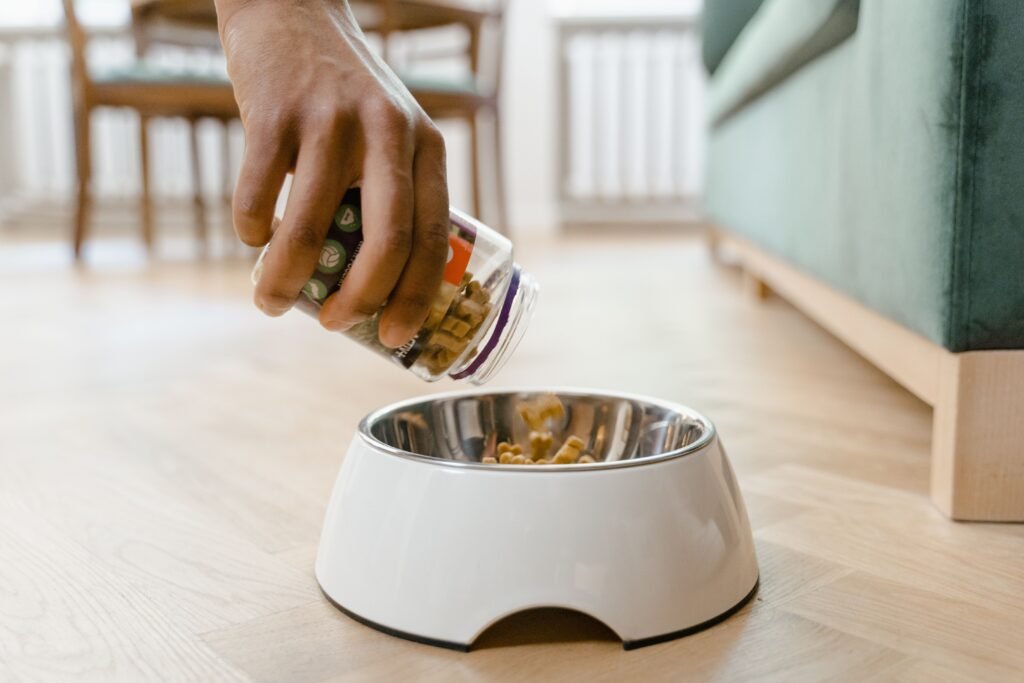
Your dog’s bowls don’t have to live in the kitchen. Kitchens are convenient because food and water are nearby, but that advantage disappears if the bowls create a trip hazard, block the dishwasher, or need to be moved every time someone cooks.
Look at the spaces immediately outside the room. A nearby dining corner, laundry entrance, mudroom, or recessed section of hallway may give your dog considerably more room while remaining only a few steps from the tap and food storage.
Before buying a special feeding station for the new location, test it for several days. Check whether your dog can approach comfortably, every nearby door can open, spilled water is easy to clean, and nobody regularly kicks or steps over the bowls. If the area passes those everyday tests, you’ve probably found a better location than anything you could force into the kitchen.
Frequently Asked Questions
Where is the best place to put dog bowls in a small kitchen?
The best spot is usually around the quiet perimeter of the kitchen, away from the main cooking and walking routes. An unused corner, the end of a cabinet run, or the outer end of an island can work well if your dog has enough room and nearby cabinets and appliances still open fully.
Can I put dog bowls beside the refrigerator?
Yes, provided the refrigerator door and drawers can open completely and your dog won’t block access while eating or drinking. Test the position during normal kitchen use before making it permanent.
Can dog bowls go under a kitchen island?
An unused island end or breakfast-bar overhang can make a good feeding area. Avoid sections used for stools, food preparation, or regular foot traffic, and make sure your dog can stand and leave comfortably.
Should dog food and water bowls be next to each other?
They can be, but they don’t have to be. In a tight kitchen, separating them slightly may use the available space better, particularly if your dog splashes water into the food bowl. The water should remain easy for your dog to access.
How do I protect the floor underneath dog bowls?
Use a waterproof, non-slip mat that extends beyond the normal splash area, wipe up water that escapes, and lift the mat periodically to check underneath. If the bowl moves while your dog drinks, stabilizing it can also reduce how far the mess spreads.
Is it okay to keep dog bowls outside the kitchen?
Yes. If a nearby dining, laundry, mudroom, or hallway area provides safer access and more room, it may be a better choice than forcing the bowls into a cramped kitchen. Keep the water readily accessible and choose a location that remains convenient to clean and refill.
Make the Bowls Fit Your Kitchen, Not the Other Way Around
Ultimately, deciding where to put dog bowls in a small kitchen isn’t about finding the narrowest gap where two bowls can physically fit. The location has to work while people are cooking, opening appliances, walking through the room, and cleaning up after everyday meals.
Start with the quiet edges of the kitchen: an unused corner, cabinet end, island end, or awkward nook that isn’t doing much else. Then test the spot instead of immediately committing to it. Watch where your dog stands, where water lands, and whether anything nearby becomes harder to use.
If none of those locations works, move the feeding area just outside the kitchen rather than creating a permanent obstacle inside it. A small home doesn’t need an elaborate dog station. It needs a well-chosen place where your dog can eat and drink comfortably without the bowls taking over the room.